


New microscopy method could lead to advancements in cell biology
Posted: 7 July 2021 | Anna Begley (Drug Target Review) | No comments yet
Researchers at UT Southwestern have invented a novel microscopy method that could open new avenues of advanced microscopy.
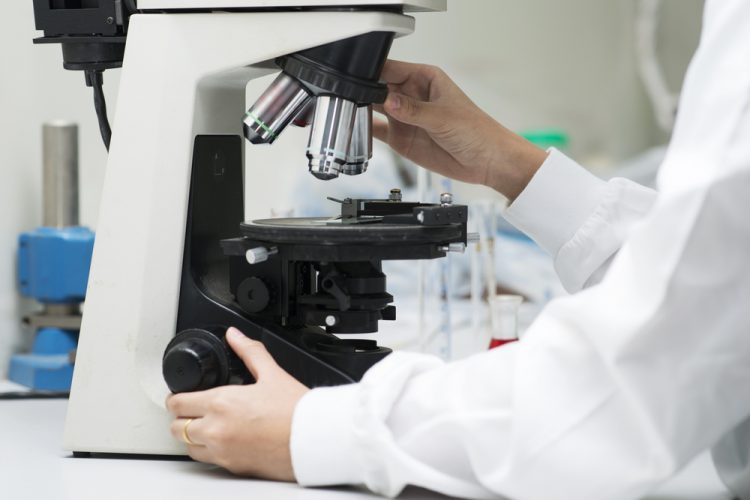
A team of scientists at the University of Texas (UT) Southwestern, US, have collaborated with colleagues in the UK and Australia to build and test a new optical device that converts commonly used microscopes into multiangle projection imaging systems, opening new avenues in advanced microscopy.
Acquiring three-dimensional (3D) image information currently requires a data-intense process in which hundreds of two-dimensional (2D) images of the specimen are assembled into an “image stack”. To visualise the data, the image stack is then loaded into a graphics software programme that performs computations to form 2D projections from different viewing perspectives on a computer screen. “Those two steps require a lot of time and may need a very powerful and expensive computer to interact with the data,” corresponding author Reto Fiolka explained.
The team realised the programme could form projections from multiple angles by optical means using a simple and cost-effective unit consisting of two rotating mirrors that are inserted in front of a camera of the microscope system. This system thus bypasses the need to acquire image stacks and render them with a computer. While an entire 3D image stack may require hundreds of camera frames, this new method requires only one camera exposure, thereby promising incredibly fast imaging.
Drug Target Review has just announced the launch of its NEW and EXCLUSIVE report examining the evolution of AI and informatics in drug discovery and development.
In this 63 page in-depth report, experts and researchers explore the key benefits of AI and informatics processes, reveal where the challenges lie for the implementation of AI and how they see the use of these technologies streamlining workflows in the future.
Also featured are exclusive interviews with leading scientists from AstraZeneca, Auransa, PolarisQB and Chalmers University of Technology.
“As a result, we can do all this in real time, without any noticeable delay… We believe this invention may represent a new paradigm for acquiring 3D information via a fluorescence microscope,” Fiolka said.
The researchers initially developed the microscopy system with two common light-sheet microscopes that require a post-processing step to make sense of the data, known as de-skewing; this essentially means rearranging the individual images to remove some distortions from the 3D image stack. The team aimed to perform this de-skewing optically but realised that when they used an incorrect amount, the projected image seemed to rotate.
“We realised that this could be bigger than just an optical de-skewing method; that the system could work for other kinds of microscopes as well,” added Fiolka.
“This study confirms the concept is more general,” co-author Kevin Dean concluded. “We have now applied it to various microscopes, including light-sheet and spinning disk confocal microscopy.”
The team have used the new microscopy method to image calcium ions carrying signals between nerve cells in a culture dish and looked at the vasculature of a zebrafish embryo. They also rapidly imaged cancer cells in motion and a beating zebrafish heart.
The invention is described in Nature Methods.
Related topics
Imaging, Informatics, Microscopy, Technology
Related organisations
University of Texas Southwestern (UT Southwestern)
Related people
Kevin Dean, Reto Fiolka
