


Researchers discover bronchospasms mechanisms using microdevice
Posted: 26 August 2019 | Victoria Rees (Drug Target Review) | No comments yet
A ‘bronchi-on-a-chip’ has been created by researchers to identify the processes of bronchospasms which could aid in respiratory disease therapies.
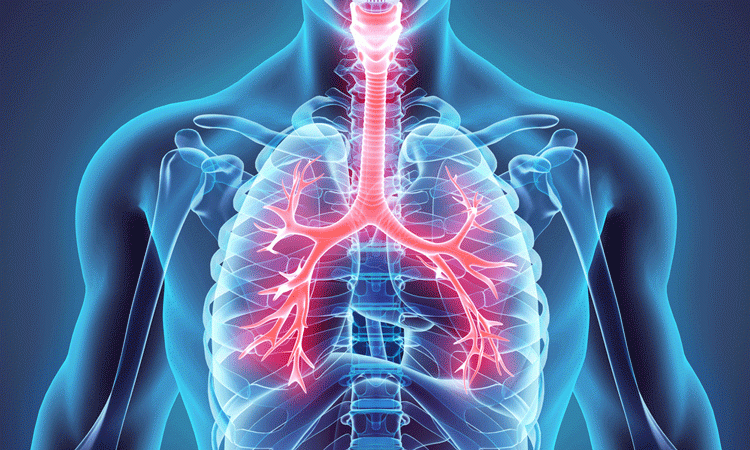
Researchers have identified how muscle contractions, or bronchospasms, occur in airways and for people with asthma. The study created a microdevice to make their discovery and believe it could aid in the development of treatments for respiratory diseases.
The research was conducted by Rutgers University, US, and other institutions. Developing a ‘bronchi-on-a-chip’, one-thousandth the size of a human hair, the team were able to study healthy and asthmatic lung cells.
When the researchers triggered a simulated bronchospasm on the device, they found that the initial contraction prompted the secretion of hormone-like compounds that either can induce an additional constriction or relax the spasm.
Drug Target Review has just announced the launch of its NEW and EXCLUSIVE report examining the evolution of AI and informatics in drug discovery and development.
In this 63 page in-depth report, experts and researchers explore the key benefits of AI and informatics processes, reveal where the challenges lie for the implementation of AI and how they see the use of these technologies streamlining workflows in the future.
Also featured are exclusive interviews with leading scientists from AstraZeneca, Auransa, PolarisQB and Chalmers University of Technology.
…inducing a second asthmatic trigger during a bronchial spasm at a precise time causes the smooth muscle to relax”
In people with asthma, the smooth muscle surrounding the airways is more reactive and contracts more easily in response to stimuli such as allergens, leading to extended bronchial spasms, wheezing and shortness of breath.
They also found that inducing a second asthmatic trigger during a bronchial spasm at a precise time causes the smooth muscle to relax, stopping the spasm.
“The microdevice allowed us to drill down into how single cells interact with each other in relation to smooth muscle contraction in a variety of lung diseases,” said co-author Reynold Panettieri, director of the Rutgers Institute for Translational Medicine and Science. “Being able to study the mechanics on the single-cell level and view thousands of cells simultaneously can be an important screening tool for the development of new drugs for people with asthma who don’t respond to current treatment.”
The study was published in Nature Biomedical Engineering.
Related topics
Drug Targets, Organ-on-a-Chip, Organoids, Research & Development
Related conditions
Asthma
Related organisations
Nature Biomedical Engineering, Rutgers University
Related people
Reynold Panettieri
