


Researchers identify potential enterovirus drug target
Posted: 19 August 2019 | Victoria Rees (Drug Target Review) | No comments yet
A study has discovered a pathway that allows the enterovirus to successfully infect cells and promote genome release which could be a therapeutic target.
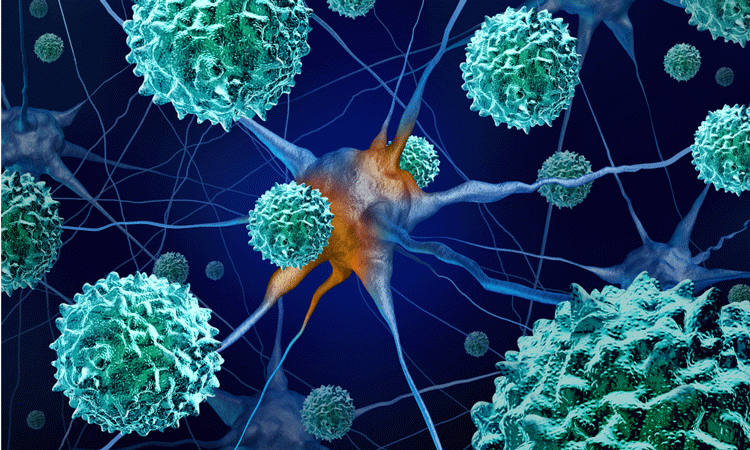
A study has discovered a key mechanism involved in successful enterovirus infection which promotes genome release. The researchers say their findings could yield targets for therapeutic development.
The research was conducted by a team from the Nanoscience Center at the University of Jyväskylä and at the University of Helsinki, both Finland.
Using real-time uncoating measurements and high-resolution structures, the scientists discovered that a molecule found in serum and interstitial fluids known as albumin and an ion composition typically developed in cellular vesicles both trigger an expansion of the virus’ outer layer.
Drug Target Review has just announced the launch of its NEW and EXCLUSIVE report examining the evolution of AI and informatics in drug discovery and development.
In this 63 page in-depth report, experts and researchers explore the key benefits of AI and informatics processes, reveal where the challenges lie for the implementation of AI and how they see the use of these technologies streamlining workflows in the future.
Also featured are exclusive interviews with leading scientists from AstraZeneca, Auransa, PolarisQB and Chalmers University of Technology.
The expanded virus then allows small molecules such as ions to enter. The researchers conclude that before entering cells, albumin primes the virus to form a metastable yet infectious intermediate particle. Ionic changes that are likely to occur in cellular vesicles further contribute to opening and promote release of the genome.

These are enteroviruses in electron microscope. Albumin helps enteroviruses to open (credit: University of Helsinki and University of Jyväskyla/Visa Ruokolainen and Ausra Domaska).
“The successful release of the genome is one of the rate-limiting steps in virus infection. It needs to occur in the right place in the right time to ensure efficient infection. This work provides new insight into understanding this fundamental aspect of enterovirus life cycle and may yield targets for therapeutic development,” said Varpu Marjomäki from the University of Jyväskylä.
The findings were published in the Journal of Virology.
Related topics
Drug Targets, Ion Channels, Research & Development, Small Molecules
Related organisations
Journal of Virology, Nanoscience Center at the University of Jyväskylä, University of Helsinki, University of Jyväskylä
Related people
Varpu Marjomäki
