


Researchers identify potential Zika Virus target
Posted: 5 May 2017 | Niamh Marriott (Drug Target Review) | No comments yet
New research provides insights into why infection with Zika virus after birth generally causes only mild symptoms, whereas devastating foetal malformations can develop when infection occurs during pregnancy.
Healthy people are protected by antiviral factors of our innate immune system. Investigators have now shown that reducing levels of one antiviral factor called interferon-induced transmembrane protein 3 (IFITM3) makes cultured cells highly sensitive to Zika virus infection.
The team found that IFITM3 normally stops multiplication of the virus in human cells at an early step, preventing the infected cells from “implosive” cell death. Therefore, drugs that block this cell death pathway might be helpful for preventing the effects of Zika virus infection during pregnancy.
“We describe a striking succession of events that may lead to the death of cells infected with Zika virus. Hopefully, the cells are equipped with antiviral gatekeepers that allow the host to control the infection,” said Dr Olivier Schwartz, senior author of the study.
Drug Target Review has just announced the launch of its NEW and EXCLUSIVE report examining the evolution of AI and informatics in drug discovery and development.
In this 63 page in-depth report, experts and researchers explore the key benefits of AI and informatics processes, reveal where the challenges lie for the implementation of AI and how they see the use of these technologies streamlining workflows in the future.
Also featured are exclusive interviews with leading scientists from AstraZeneca, Auransa, PolarisQB and Chalmers University of Technology.
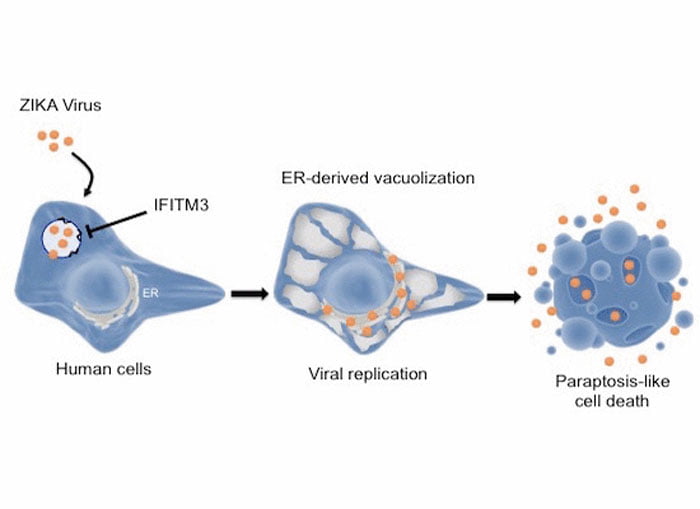
In human cells, Zika virus (ZIKV) replication occurs in ER‐derived membranes and triggers the formation of large ER‐derived vacuoles leading to “implosive” paraptosis‐like cell death.
- IFITM3 prevents early stages of ZIKV life cycle.
- ZIKV induces massive ER‐dependent cytoplasmic vacuolization in human epithelial cells, primary human fibroblasts and human astrocytes.
- ZIKV induces paraptosis‐like, caspase‐independent cell death.
- ZIKV‐induced vacuoles are dependent on viral translocation into ER through Sec61 and on PI3K/Akt signaling.
Related topics
Antibiotics, Antimicrobials, Biomarkers, Drug Targets, Research & Development, Stem Cells, Target Validation, Vaccine
Related conditions
Zika virus
Related people
Dr Olivier Schwartz
