


Metal-based fragment molecule library to screen for drug candidates
Posted: 20 January 2020 | Victoria Rees (Drug Target Review) | No comments yet
Researchers have developed a novel metal-based fragment library of molecules that can be used to screen for new drug candidates.

A new library of drug compounds has been developed which includes metal-based three-dimensional (3D) fragments; an advance on most libraries which only contain one- and two-dimensional shapes, say the researchers.
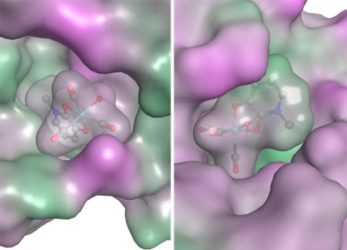
In the image, fragments and protein are shown with molecular surface maps coloured to indicate lipophilicity. Hydrophilic and lipophilic regions are represented by pink and green surfaces, respectively (credit: Seth Cohen, UC San Diego).
A study, conducted at the University of California (UC) San Diego, US, demonstrated how shape plays a key role in dictating the biological effects of molecules, informing fragment-based drug discovery (FBDD). The team used a novel type of metal-based molecular building block to serve as a basis for developing new therapeutics.
“The reason we used these is because they have unique shapes that are not readily achieved by organic or metal-free molecular building blocks. These unique shapes allow them to bind to important biomolecules for treating disease,” explained lead researcher Professor Seth Cohen. “This research could open up new avenues for discovering drugs to treat life-threatening illnesses such as cancer, influenza or multidrug resistant bacteria.”
Drug Target Review has just announced the launch of its NEW and EXCLUSIVE report examining the evolution of AI and informatics in drug discovery and development.
In this 63 page in-depth report, experts and researchers explore the key benefits of AI and informatics processes, reveal where the challenges lie for the implementation of AI and how they see the use of these technologies streamlining workflows in the future.
Also featured are exclusive interviews with leading scientists from AstraZeneca, Auransa, PolarisQB and Chalmers University of Technology.
The researchers focused on 3D mononuclear complexes as structural scaffolds that can be grown into drug-like molecules by modifying specific parts of their fragments. This led to a metallofragment (mF) library which included 13 classes of complexes.
The team then screened these against three therapeutic targets including portions of the H1N1 influenza virus, NDM-1 (found in some antibiotic-resistant bacteria) and an anti-cancer target. This showed that the mF platform was successful and could be effective for future FBDD studies.
“We hope, in an ideal scenario, that in eight to 10 years’ time, some of these building blocks will begin to find their way into new drug candidates that are providing life-saving cures for human health,” said Cohen.
The study was published in Chemical Science.
Related topics
Drug Leads, Drug Targets, Research & Development, Screening
Related conditions
antibiotic resistance, Cancer, Influenza
Related organisations
University of California San Diego
Related people
Professor Seth Cohen
