


Protein vital for breast cancer metastasis discovered
Posted: 11 September 2019 | Victoria Rees (Drug Target Review) | No comments yet
A research team have identified a protein that binds breast cancer cells together, allowing them to metastasise, which could be significant in the development of cancer therapies.
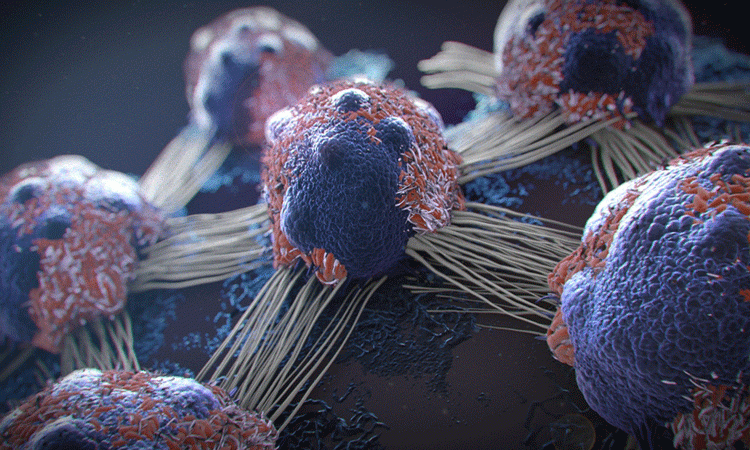
Researchers have found that a cell adhesion protein that allows breast cancer cells to survive and metastasise. According to the team, their findings could lead to new ways to prevent breast cancers, including ductal carcinoma, from recurring in patients.
The research team tested the role of the protein in three experimental models of invasive ductal carcinoma: luminal, basal and triple negative”
The research was conducted by the Johns Hopkins Kimmel Cancer Center, US. The scientists used mice models to discover that the protein E-cadherin limits molecular stresses within cancer cells enabling them to survive long enough to spread.
“Previously, researchers thought that it was essential for cancer cells to lose E-cadherin in order to metastasise,” said study leader Professor Andrew Ewald, co-director of the Cancer Invasion and Metastasis Program at Johns Hopkins Kimmel Cancer Center. “This was difficult to reconcile with the fact that breast tumours in patients typically continue to express E-cadherin. Our study was designed to test the role of this protein during metastasis.”
Drug Target Review has just announced the launch of its NEW and EXCLUSIVE report examining the evolution of AI and informatics in drug discovery and development.
In this 63 page in-depth report, experts and researchers explore the key benefits of AI and informatics processes, reveal where the challenges lie for the implementation of AI and how they see the use of these technologies streamlining workflows in the future.
Also featured are exclusive interviews with leading scientists from AstraZeneca, Auransa, PolarisQB and Chalmers University of Technology.
Previous studies have shown that in some breast cancers, genetic mutations eliminate E-cadherin which appears to be vital for metastasis. However, for ductal carcinoma, this protein is retained and even overexpressed.
The research team tested the role of the protein in three experimental models of invasive ductal carcinoma: luminal, basal and triple negative.
During cancer invasion, the E-cadherin gene dramatically increased the cells ability to invade healthy tissue. They also found that losing E-cadherin resulted in a lack of metastasis in all three breast cancer models.
The researchers observed that cells without E-cadherin got lost while migrating and died in large numbers after leaving the primary tumour. They discovered that the few cells that survived did not proliferate in new organs.
“Our study reveals that the process of metastasis, even in ideal laboratory settings, appears to be exceedingly inefficient,” said Ewald.
The team concluded that breast cancer cells need adhesive connections to survive and eventually spread and kill patients, which can inform the development of future treatments.
The findings were published in Nature.
Related topics
Drug Targets, Genetic analysis, Oncology, Research & Development
Related conditions
ductal carcinoma
Related organisations
Johns Hopkins Kimmel Cancer Center
Related people
Professor Andrew Ewald
