


Gene discovery could lead to new treatments for sepsis
Posted: 22 October 2015 | Victoria White
Scientists have isolated the gene that produces Gasdermin-D – a protein that plays a critical role in the pathway to sepsis…
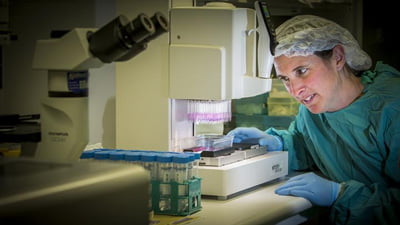
Linda Fitzgerald is shown with a multi-pipettor at the Australian Phenomics Centre. CREDIT: Stuart Hay, ANU
Scientists have identified a gene that could lead to the development of new treatments for the lethal disease sepsis.
Researchers from The Australian National University (ANU) and the Garvan Institute of Medical Research worked with Genentech to identify a gene that triggers the inflammatory condition that can lead to the full-body infection sepsis.
Drug Target Review has just announced the launch of its NEW and EXCLUSIVE report examining the evolution of AI and informatics in drug discovery and development.
In this 63 page in-depth report, experts and researchers explore the key benefits of AI and informatics processes, reveal where the challenges lie for the implementation of AI and how they see the use of these technologies streamlining workflows in the future.
Also featured are exclusive interviews with leading scientists from AstraZeneca, Auransa, PolarisQB and Chalmers University of Technology.
Sepsis is a severe whole-body infection that kills an estimated one million people in the US alone each year. It occurs as a complication to an existing infection, and if not treated quickly can lead to septic shock and multiple organ failure, with death rates as high as 50%.
Researchers were aware that sepsis occurs when molecules known as lipopolysaccharides (LPS) on the surface of some bacteria infiltrate cells, triggering an immune response that causes the cells to self-destruct. But exactly how the self-destruct button was pressed remained a mystery.
Gasdermin-D plays a critical role in the pathway to sepsis
The team found the protein Gasdermin-D plays a critical role in the pathway to sepsis.
Scientists at Genentech showed that Gasdermin-D usually exists in cells in an inactive form. When the LPS molecules enter the cells they trigger an enzyme called caspase-11, a kind of chemical hatchet, to lop the protective chemical cap off Gasdermin-D, which in turn leads the cells to self-destruct.
The team at the Australian Phenomics Facility then screened thousands of genes with a large-scale forward genetics discovery platform and in a little over a year had isolated the gene that produces Gasdermin-D.
Nobuhiko Kayagaki, PhD, Senior Scientist from Genentech, said the work will help researchers understand and treat other diseases as well as sepsis.
“The identification of Gasdermin-D can give us a better understanding not only of lethal sepsis, but also of multiple other inflammatory diseases,” he said.
“This finding is a key that could potentially unlock our ability to shutdown this killer disease before it gets to a life-threatening stage,” said Professor Chris Goodnow from ANU and Garvan Institute of Medical Research.
Related topics
Drug Discovery
Related conditions
Sepsis
Related organisations
Australian National University, Garvan Institute of Medical Research, Genentech
